
Belmont Projected Versus Actual Release
A projected date is a calculation or eligibility marker based on facts known at that time. An actual date records a completed exit from a specific custodian. Belmont's live jail roster can show a future Release Date while the person remains on the current list. ODRC uses the exact combined label “Expected Release Date/Parole Eligibility Date.” Neither display should be renamed as a confirmed release.
Pretrial detention has no set sentence-completion date. Bond, recognizance, dismissal, a court order, a detainer, or later sentencing may control departure. A sentenced jail term can be computed, but qualifying work credit and a new judicial entry may affect it. A state-prison date also depends on sentence type, jail-time credit, earned credit, parole rules, and later legal events.
Find Belmont Projected Release Dates
Start by identifying who holds the person now. The sheriff roster covers Belmont County Jail. ODRC covers Ohio prisons, including Belmont Correctional Institution. A person absent from the jail roster but shown as Incarcerated by ODRC transferred into state custody and was not released to the community.
- Check the Belmont roster for the court, disposition, book date, and displayed release date.
- Ask the jail at 740-695-5124 whether the person remains held and whether another agency has a hold.
- Use the named court docket for bond, sentence, jail-time credit, and later orders.
- For state custody, search ODRC Offender Search by name or ODRC number.
- Open the detail and transcribe the combined expected-release/parole-eligibility label exactly.
- Compare status, offenses, sentence terms, jail-time credit, board review, and supervision fields.
- Recheck near the date and obtain the actual release or discharge record afterward.
The official ODRC search provides name, status, county, offender-number, and hearing-month controls.
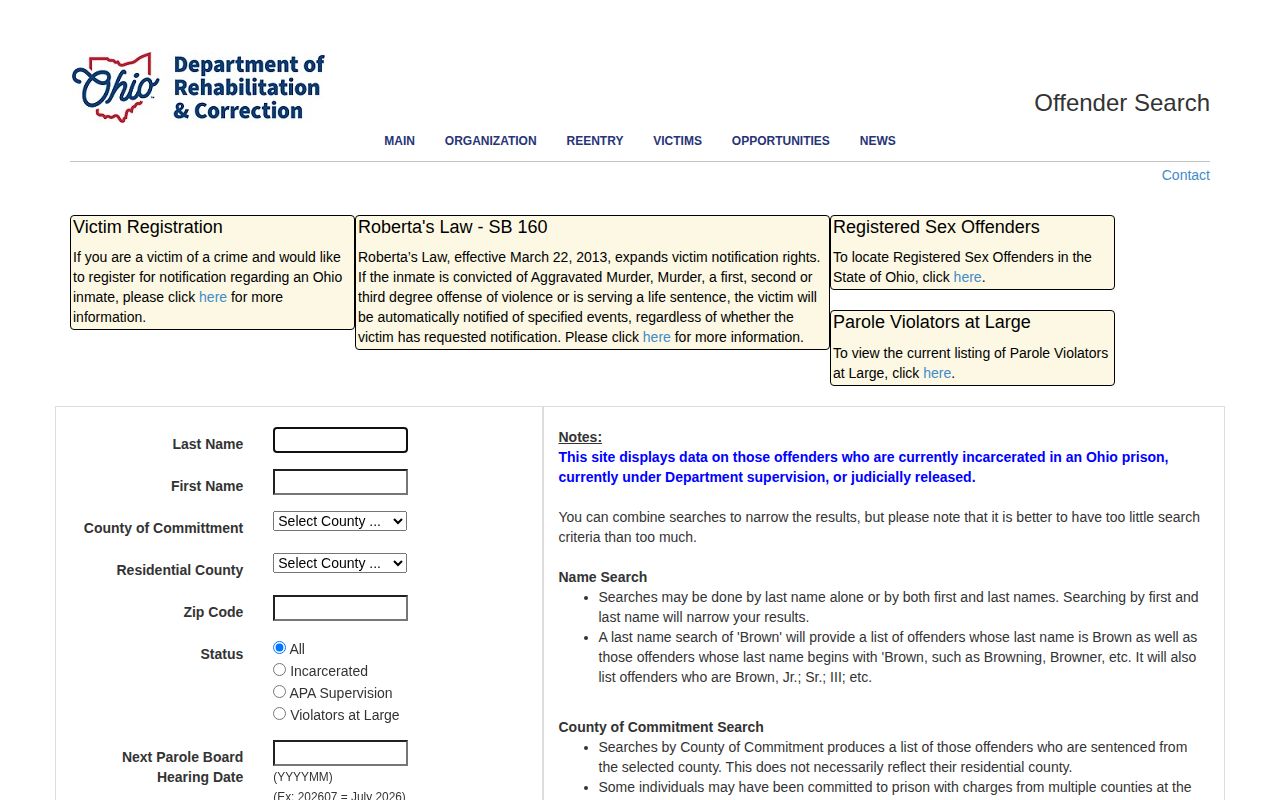
The search screen is only the first step. The individual detail and sentencing docket supply the context needed to interpret a date.
Ohio Earned Credit Calculations
ORC 2967.194 sets Ohio's current earned-credit framework. Subject to eligibility and limits, a confined person may provisionally earn one or five days for each completed month of productive participation in an approved program. Successful work in a second qualifying activity can provisionally add up to five more days. Credits are tracked monthly and may be denied or withdrawn after rule violations.
The law also provides a distinct completion credit for eligible people who complete listed programs or criteria. It may be 90 days or ten percent of the stated term, whichever is less, for each qualifying completion. Mandatory terms, violent and sexually oriented offenses, life without parole, and other listed exclusions can bar or limit credit. The ordinary participation credits have an aggregate ceiling of fifteen percent of the stated term.
The official earned-credit statute shows the operative amounts, ceiling, and exclusions.
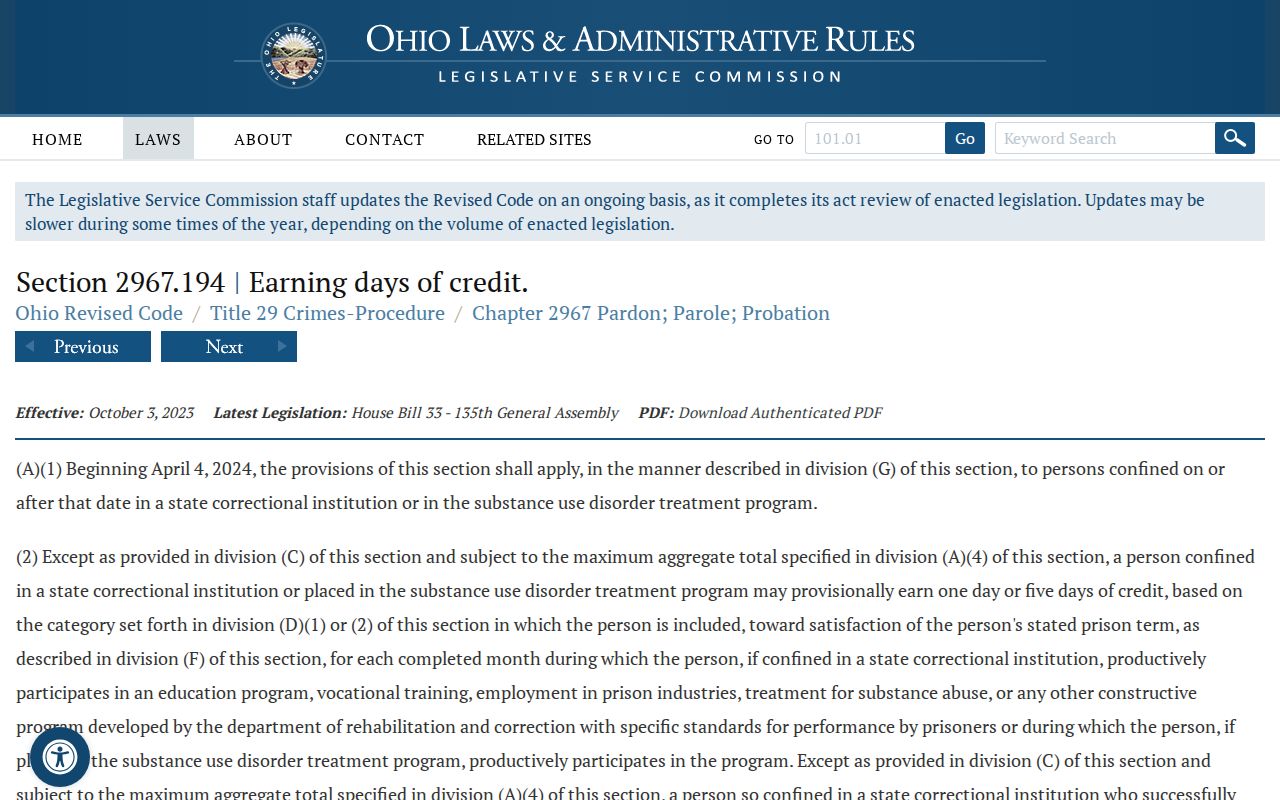
The statutory detail explains why sentence length alone cannot produce a reliable Belmont state-prison release date.
What Changes Belmont Release Dates
A public date can move when the inputs or legal status change. Some changes affect the computation. Others affect whether the person actually walks out on the computed day. Read the latest status and do not rely on a saved screenshot alone.
| Factor | Possible effect |
|---|---|
| Jail-time credit | Reduces the term by court-certified days |
| Earned credit | May move an eligible ODRC date earlier |
| Credit loss | Can remove provisional reductions |
| Court modification | Changes sentence or certified credit inputs |
| Parole decision | An eligibility date may lead to grant, denial, or later review |
| Detainer or other hold | Can cause transfer instead of community release |
| Indefinite-term review | Can continue custody within the imposed maximum |
ODRC says a disputed judicial jail-time-credit figure must go back to the sentencing court. Under OAC 5120-2-04, ODRC does not change the certified amount unless the court issues a modifying entry.
Confirm Belmont Actual Release
For county custody, pair the sheriff's actual release entry with the order from the court named on the roster. Ask for actual release date and time, release authority or type, and receiving agency when the event was a transfer. For state custody, look for Released or APA Supervision status, a supervision start, the sentencing docket, and a responsive ODRC discharge record.
The ODRC print-detail example shows the combined date label beside sentence and supervision fields.
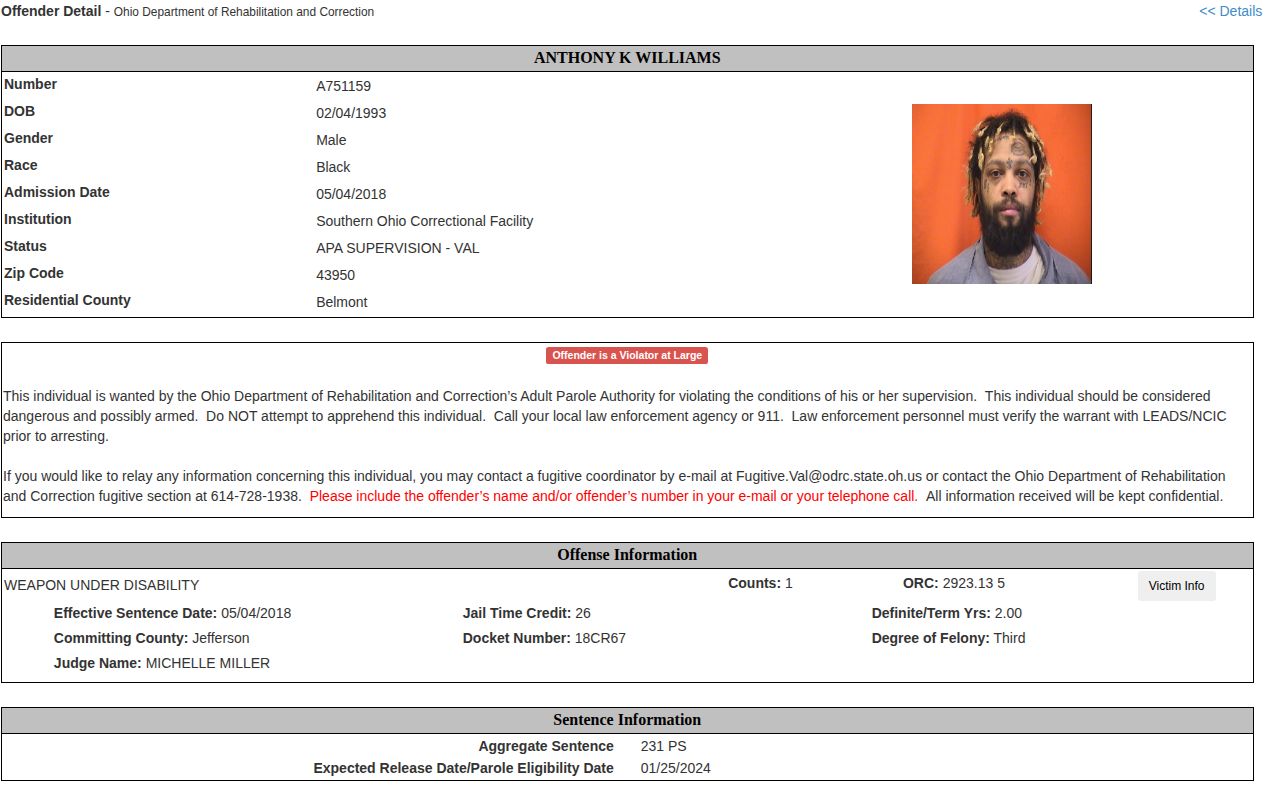
Those adjoining fields must be read together. A future date alone is not proof of a scheduled walk-out.
Ohio VINE can send a custody-change alert, but it can lag and does not replace the source record. Registration steps appear on the Belmont County VINELink inmate search page.
Belmont Jail Work Credit
County-jail work credit is not the same as ODRC program credit. ORC 2947.151 permits a sheriff to allow up to three days of reduction per thirty days for a sentence of 90 days or less, up to four days per thirty for a term over 90 days through six months, and up to five days per thirty for a longer sentence. The reduction depends on qualifying work and becomes effective only with written concurrence from the presiding or sentencing judge or magistrate.
It is discretionary. Do not subtract it from every Belmont County Jail sentence. The sheriff and sentencing court must confirm whether it applies to the individual computation.
Belmont Weekend Release Claims
No statewide Ohio law was verified that automatically moves a county-jail release falling on a weekend or holiday to Friday. ORC 2947.151 concerns work credit, not a weekend rule. Belmont's processing time and holiday practice must be confirmed with the jail.
A separate local instruction applies only to people sentenced to weekends or work release. The sheriff directs them to the Inmate Support Officer at 740-695-7933 extension 155 for arrangements or payments. That narrow process must not be generalized into ordinary bond or sentence-completion release.
Ohio Sentence Era Differences
Ohio computations vary by sentence era. OAC 5120-2-03.2 distinguishes pre-Senate Bill 2, Senate Bill 2, House Bill 86, and qualifying Senate Bill 201 non-life indefinite sentences. The rule describes different monthly credit structures. Consecutive terms add sequencing rules. A formula from one era should not be applied to another Belmont prison record.
Qualifying non-life indefinite terms under ORC 2967.271 add another layer. The law presumes release at the minimum term or a presumptive earned early-release date, whichever is earlier, but permits proceedings that may continue confinement up to the imposed maximum. This is not a definite-term expiration or an ordinary parole hearing.
Belmont Parole Eligibility Dates
The ODRC field combines two concepts because the sentence controls its meaning. For an eligible indefinite sentence, the date may mark when parole can first be considered. It does not promise a grant. For a definite sentence, the same field can act more like a computation estimate. Status, sentence type, board results, and court records show which reading fits.
A hearing result also needs context. A grant may depend on plan approval or other conditions. A denial or continuance means release was not approved at that review. Transitional-control and reparole entries concern different paths. Preserve the exact wording rather than shortening every favorable event to release granted.
When ODRC later shows APA Supervision with a supervision start, that combination is stronger proof prison custody ended. It still does not prove final discharge. APA authority may continue, and a later violation can change status.
Request Belmont Date Records
If public fields do not resolve the date, write to the record owner. Ask the sheriff for a county booking and actual release or transfer record. Ask the named court for the sentencing entry, bond order, jail-time credit, and modifications. Ask ODRC for public prison admission, computation, release, discharge, and supervision information.
ODRC publishes P.O. Box 430, Columbus, Ohio 43216 and 614-752-1161 for Offender Search questions. Identify the person by full name and ODRC number. A narrow request is more useful than asking for an entire institutional file, which can contain confidential material. The sheriff remains the custodian for a Belmont-only jail event.
Record the date the public page was checked. A computation can change after credit review, discipline, a court entry, or a board action. If an expected date passes while ODRC still reports Incarcerated, rely on current status and ask ODRC to explain the public computation rather than declaring the person released. Keep that response with the docket and later discharge record so the full Belmont custody timeline remains clear.
Read Belmont Jail Release Dates
The sheriff's New Inmate Roster is a current-population snapshot. Its Release Date field can show a future date for someone who remains listed. The same record can show court, current disposition, bail, book date, next court date, and arresting agency. Those fields supply context, but none alone records a completed walk-out.
A disposition such as Court Release, Own Recognizance, or Case Dismissed reflects court action. Jail staff may still need to complete checks, property return, paperwork, or a hold review. Likewise, Hold For Other Agency points toward transfer rather than community release. Request the maintained release record for the actual physical exit and destination.
No exact public update cadence or departed-name retention period is published. A name disappearing between roster snapshots shows only that it left the current view. It does not establish the hour, date, reason, or destination. The sheriff and named court supply those facts.
Bond paperwork also starts a process rather than proving its completion. Belmont publishes a bond schedule, and the sheriff says a bondsman brings arranged paperwork to the jail. Confirm the actual exit with the jail rather than using payment or a court order as a substitute timestamp.