
Belmont Jail Release Destinations
Belmont County Jail holds adults at several points in the local court process. Some are waiting for trial or sentencing. Others await transfer to an Ohio state institution, return to another state, or proceedings tied to probation or parole revocation. That mix makes the word “release” easy to overread. A person who finishes Belmont County Jail processing may go home, but may instead move directly into ODRC, another county's custody, federal custody, or the custody of the jurisdiction that issued a warrant.
For a community exit, the sheriff's maintained booking and release record should supply the physical release date and time, release authority or type, and destination if those fields are maintained. The matching docket supplies the legal event, such as bond, recognizance, dismissal, time served, or a court release. These records complement each other. The court order does not prove when jail staff completed processing, while a roster change does not explain the legal basis or receiving agency.
Confirm a Belmont Jail Release
The sheriff publishes a live New Inmate Roster, divided by sex and marked with a run date and time. It is a current-population report, not a completed-release archive. A present entry can even show a future release date. That date may reflect scheduling or sentence computation while the person is still confined, so it cannot stand alone as proof that the jail door has opened.
Use a short sequence that preserves the difference between legal status and physical custody:
- Search the live roster by the person's exact name and compare Jail ID, SID, book date, charges, and arresting agency.
- Note the named court and disposition, then check the correct county division or Common Pleas docket for the controlling order.
- If the name has left the roster, call jail booking for a current location question.
- Request the actual booking and release or transfer record for lasting proof.
- If the record names ODRC or another agency, continue the search in that agency's system.
The broader Belmont County released-inmate search explains how the county, court, ODRC, VINE, and federal routes fit together. None should be substituted for the sheriff's own record of a Belmont jail exit.
Belmont Jail Roster Clues
The roster exposes useful identifiers even though it does not retain a published list of people released during the last day or three days. Capture the exact record before it changes. A future or blank release field needs context from the disposition and the jail. “Court Release,” “Own Recognizance,” and “Case Dismissed” describe legal developments, but none timestamps the end of physical processing.
| Roster field | How it helps |
|---|---|
| Jail ID and SID | Distinguish people with similar names and narrow a records request. |
| Book date and arresting agency | Identify the custody episode and originating agency. |
| Court and current disposition | Route the user to the docket that explains the legal action. |
| Charges, bail, attorney, next court date | Provide case context while the entry remains current. |
| Release date | A clue that must be checked against current custody and the final record. |
No official recent-release feed, departed-name retention period, or exact roster refresh promise was found. A vanished row cannot safely be assigned to a specific release window.
Belmont Jail Release Records
The sheriff's public-record portal is the formal route after a person drops from the live roster. Choose “Other” and describe one booking with enough precision to locate it. Ask for the booking/release record, actual release date and time, release type or authority, receiving agency or destination if recorded, and booking photograph if needed. A narrow request avoids sweeping in medical, security, juvenile, sealed, or other restricted information.
68137 Hammond Road
St. Clairsville, OH 43950
Main: 740-695-7933
Jail: 740-695-5124
Jail booking: extensions 118/119
Fax: 740-695-4781
The portal allows the requester's name to be optional, but the office still needs a contact route for questions about scope or cost. It says someone will contact the requester within three business days regarding the request. That is not a promise of production within three days. Email is listed as no charge; the printable form gives separate paper, disc, USB, and postage costs.
Belmont County Jail Profile
The official Belmont County Jail page identifies this as a full-service adult county jail serving the sheriff and police departments throughout Belmont County. Its population can range from people accused of minor traffic offenses to people facing the most serious cases. The facility also holds fugitives awaiting return and people waiting for state transfer or revocation proceedings. These roles explain why there is no single post-roster destination.
The official jail source shown below links the roster and explains local bond and weekend/work-release procedures.
View the Belmont County Sheriff's jail source before using the captured page as context.
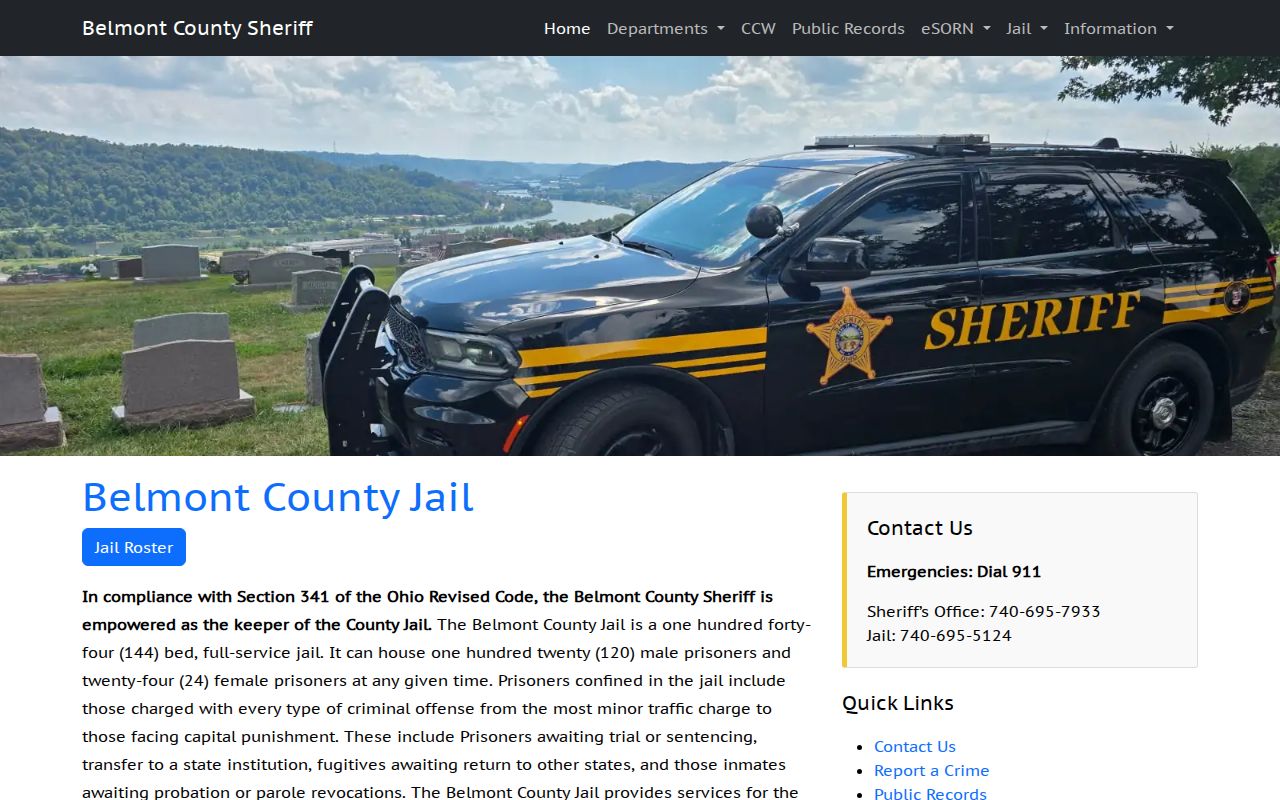
The image supports the jail-specific route, while the live page should be checked for later changes.
Belmont Jail Court Verification
The court named on the roster determines where to verify the order behind a Belmont County Jail release. Northern, Eastern, and Western Division Court cases use the county courts' eServices system. Common Pleas is separate, and its clerk says CourtView dockets are online from 1995 forward. Searching the wrong division can create a false impression that no case exists.
Use the docket for bond, recognizance, dismissal, sentencing, jail-time credit, community control, or an ODRC commitment. Then compare that entry with the sheriff's actual exit record. Community control is a court-supervised sanction often called probation; it may continue after physical release. A commitment to ODRC means custody continued in the state system. If a name or case is absent online, contact the clerk named by the roster rather than guessing from the gap.
Note: A court order explains authority, but the sheriff record best documents the date and route of the physical jail departure.
Belmont Release Facilities Differ
Belmont County contains four nearby but legally distinct custody settings. The adult county jail is one. Belmont Correctional Institution is an ODRC state prison. Sargus is a juvenile detention center, and Oakview is a juvenile residential placement. A shared St. Clairsville area does not create a shared roster, records office, or access rule.
A Belmont County Jail row concerns an adult local booking. A BeCI departure belongs to the statewide ODRC offender and discharge framework. Sargus and Oakview departures must go through juvenile-court or facility channels under confidentiality limits. Moving a youth inquiry into the adult jail roster or using the sheriff record to describe a prison discharge would connect the wrong person, agency, and legal process. The facility name must be confirmed before any release search begins.
Belmont Weekend Release Arrangements
The sheriff publishes an unusually narrow instruction for people sentenced to weekends or work release. They should contact the Inmate Support Officer at 740-695-7933, extension 155, to make arrangements and payments. This direction applies to that defined sentence structure. It does not replace booking staff, a bondsman, the court, or the records portal for ordinary release questions.
Weekend custody can create a repeating pattern of entry and exit rather than one final discharge. Work release also permits a defined movement under court and jail rules, not an unrestricted release. Record each episode and ask staff which date or status is being confirmed. For bond, the sheriff says a bondsman presents paperwork to start release processing. Presentation starts the process but does not prove the person has physically left.
Note: Call the Inmate Support Officer only for the weekend or work-release process the jail assigns to that role.
Public Record Search
Sponsored Results
Belmont Jail Transfer Follow-Up
The jail holds people awaiting state transfer, fugitives awaiting return to other states, and people held for probation or parole revocation. Each group needs a different next record. A newly sentenced person transferred to state prison should appear in ODRC Offender Search after state intake. A fugitive's sheriff release record may instead name the state or jurisdiction taking custody. A revocation detainee may return to supervision, remain held after a court action, or move into another correctional setting. The receiving agency, not roster disappearance, controls the next lookup.
Federal custody creates another boundary. The sheriff says the jail serves unspecified federal agencies, but the reviewed sources do not establish a permanent federal or ICE detention facility in Belmont County. Compare a local record with the federal docket, and use BOP after federal designation. A person transferred under an immigration detainer has left county custody without necessarily entering the community.
These distinctions improve a written request. Ask for the destination or receiving agency “if recorded” instead of assuming the person went home. Include the approximate booking date, Jail ID or SID when known, and court. The sheriff can then identify the correct custody episode without being asked to interpret another agency's later record.