
Belmont Three-Day Release Findings
The Belmont County Sheriff's jail page points to one public Jail Roster. The linked New Inmate Roster is divided by sex and displays a run date and time, current totals, and individual custody entries. It offers no 72 Hour, Released, Recent Releases, or date-range view. The reviewed public interface also gives no retention period for departed names and no exact refresh promise.
That negative finding changes the method. A three-day result must be assembled from official event records, not inferred from a single current snapshot. A name found on Monday but absent on Thursday establishes a change in the public roster between those observations. It does not establish the exact hour, legal authority, or destination. The jail booking/release record supplies those facts when maintained.
Check Belmont 72-Hour Release Records
Start with the last known Belmont County Jail entry and preserve identifiers before it changes. The three-day window is most useful when the inquiry spans a weekend or when the release was not noticed on the day it occurred.
- Open the current roster and write down its run date and time.
- Search the person and retain the Jail ID, SID, book date, court, charge, disposition, bail, arresting agency, and release-date entry.
- Compare any prior timestamped official roster note available from within the three-day period.
- Call booking at 740-695-5124, extensions 118 or 119, and ask whether the person left jail, when processing ended, and whether another agency received the person.
- Search the court named on the roster for the order behind bond, recognizance, dismissal, sentence completion, community control, or transfer.
- Submit a focused public-record request if a written release date, time, type, and destination are needed.
The narrower Jail Releases: 24 Hours method fits a same-day event. The 72-hour method differs by reconciling multiple timestamps and the court activity that may cross nonbusiness days.
Belmont 72-Hour Release Fields
Belmont's public fields identify a booking and its court context. They do not form an official three-day feed. The table separates what can be copied from the current roster from what should be requested after a person drops from view.
| Field | Three-day use |
|---|---|
| Roster run date/time | Dates each public observation and bounds the period of change. |
| Name, Jail ID, SID | Links roster, jail record, and court docket to the same person. |
| Book date and agency | Identifies the custody episode and arrest source. |
| Charge, court, disposition | Routes the inquiry to the right docket and legal action. |
| Release Date | May be a future date for someone still held; it needs confirmation. |
| Actual release date/time | Request this to place physical departure inside the 72-hour window. |
| Release authority/type | Distinguishes bond, recognizance, dismissal, time served, and other grounds. |
| Receiving agency/destination | Shows whether local departure was a transfer instead of community release. |
The live roster source shows the field layout and timestamped nature of the public report.
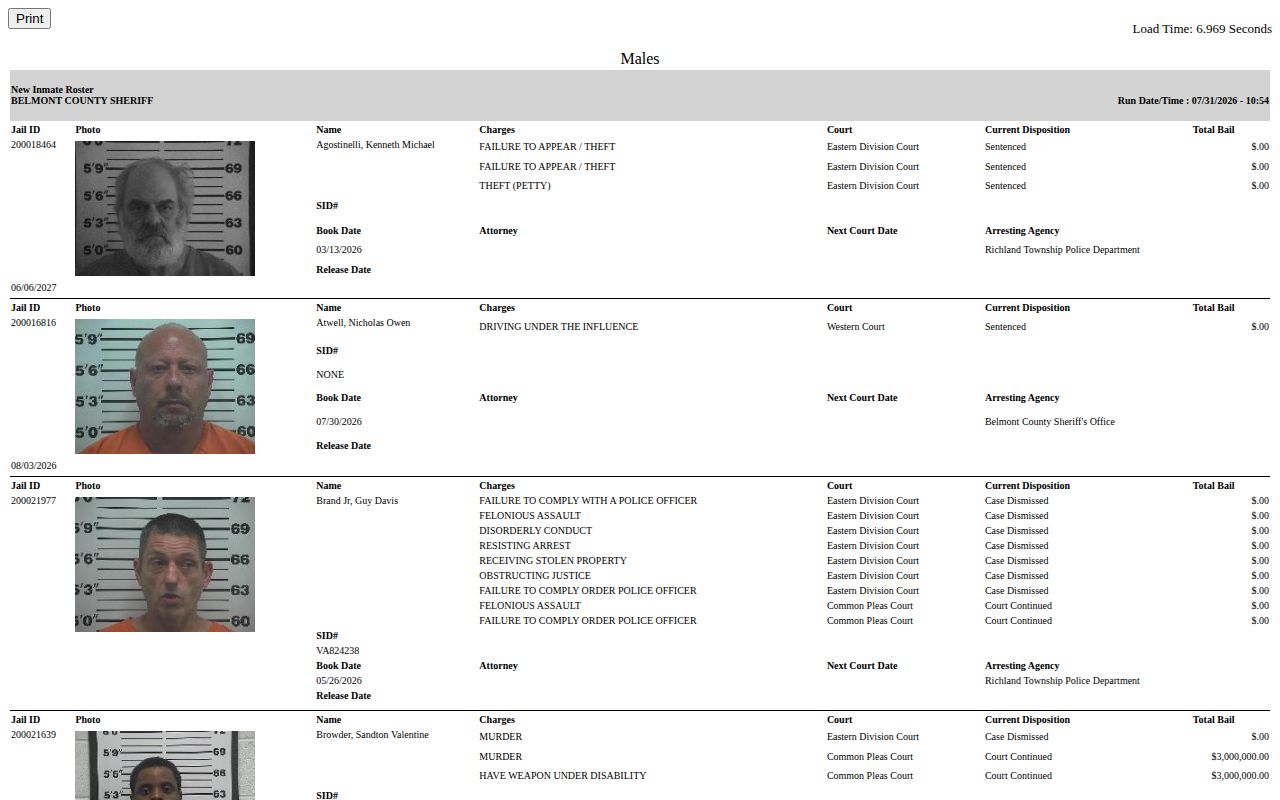
Its visible release-date column must be read alongside current listing status, court information, and later jail confirmation.
Belmont Weekend Release Timing
A 72-hour review is valuable around Friday through Monday because court action and jail processing can fall on different dates. Bond paperwork begins a process. The sheriff explains that a bondsman arranges the transaction and brings papers to the jail, while the county courts publish the applicable bond information route. Neither source turns a payment or order into proof of the minute of physical exit.
Use the jail's maintained entry to place the event in the correct window. Staff may need to complete paperwork, check holds, return property, and record the release after the court acts. A hold for another agency can keep the person in custody or lead to transfer even when one Belmont case permits release. The research found no official rule promising that a weekend event appears online by a set hour.
Belmont also publishes a narrow instruction for people sentenced to weekends or work release: contact the Inmate Support Officer at 740-695-7933 extension 155 for arrangements or payments. That program-specific direction is not the normal process for bond, recognizance, or sentence completion and should not be used to interpret ordinary releases.
Roster Changes Are Not Releases
The current roster may show a future release date for a person who remains held. Its disposition field may say Court Release, Own Recognizance, Case Dismissed, Sentenced, or Hold For Other Agency. Those labels give case context, but a legal disposition and actual jail departure are separate facts. Multiple charges may also have different results.
A disappeared name is equally ambiguous. Belmont County Jail houses people awaiting state placement, extradition, and revocation proceedings as well as local defendants. A transfer to the Ohio Department of Rehabilitation and Correction ends the county-jail stay but begins or continues state custody. An ODRC search can confirm the next custody stage. A turnover to another county, the U.S. Marshals Service, or ICE must be followed through that receiving system.
- Community release
- The person physically leaves confinement under bond, recognizance, time served, or another lawful basis.
- Transfer
- The person exits Belmont County Jail but remains in another agency's custody.
- Roster absence
- The person is not in that timestamped public snapshot; the reason remains unproved until confirmed.
Note: A three-day comparison narrows when a public listing changed, but only the jail release entry fixes the physical departure time.
Request Belmont Release Confirmation
Use the sheriff's public-record portal when direct booking confirmation is not enough. Choose Other and ask for the booking/release record for the named person, supplying a date of birth or Jail ID and approximate booking date when known. Request the actual release date and time, release authority or type, and receiving agency or destination if maintained. A narrow request is more useful than asking for every jail document.
The portal allows email, paper, disc, USB, and mail delivery. The printable form identifies email as no charge. It lists black-and-white letter pages at $0.10 each, color pages at $0.20, discs at $1, variable approved USB cost, and postage for mail. The office says someone will contact the requester within three business days about the request. That is a contact statement, not a promise that all records will be produced within three days.
The official records portal shows the Other request category and available delivery routes.
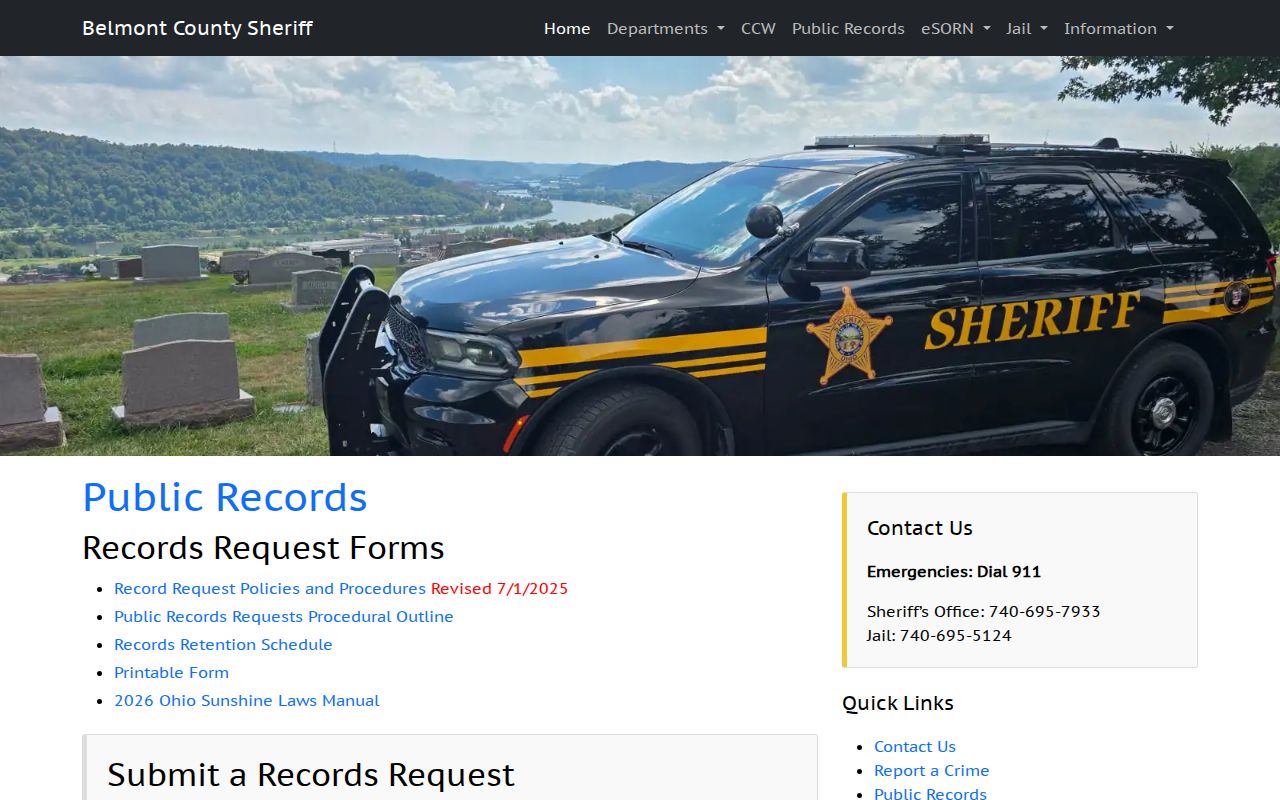
The form is the stable local fallback when a departed name no longer appears in the current public population.
Verify Belmont Release Authority
Use the court named in the roster. Northern, Eastern, and Western Division cases are available through Belmont County Courts eServices. Common Pleas cases use CourtView, and the Clerk states that online dockets run from 1995 forward. Look for bond or recognizance orders, dismissals, jail-time credit, sentence entries, community control, and commitments to state custody.
Ohio VINE can serve as an event alert for participating county jail and ODRC custody, but it is not a lasting released-person database. An alert needs confirmation from the reporting agency. ODRC Offender Search applies when the person entered state custody or supervision. For a short county-only jail stay, the sheriff record and local docket remain the main sources. The full Belmont County released inmates lookup explains those separate custody paths for one named person.
Trace Belmont Transfers Across Three Days
A wider window makes custody transfers easier to spot, but only if each system is treated separately. Belmont County Jail serves local police departments and also houses people awaiting transfer to a state institution, return to another state, and probation or parole revocation. Its public page also mentions service to unspecified federal agencies. None of those categories proves that a departed person returned to the community.
When a roster entry says Sentenced or Hold For Other Agency, compare the court order with the maintained release or transfer record. Ask the jail for the receiving agency or destination if recorded. A commitment to ODRC should lead to Ohio's Offender Search after state intake. A county name disappearing before the ODRC entry becomes visible may reflect processing lag, so describe the status as a pending transfer check instead of filling that gap with an assumed release.
Federal custody needs another path. A person held locally for the U.S. Marshals Service may later move to a contracted jail or federal facility. The Bureau of Prisons locator is designed around federal sentence custody and can show a past release date for a released federal prisoner, but it is not a complete pretrial history. Immigration custody also has its own locator, and a local handoff tied to an immigration detainer is a transfer from Belmont custody rather than release home.
Keep a short timeline for the 72-hour review: roster run time, last confirmed local listing, court-entry time, jail departure time, receiving agency, and first confirmed entry in the next system. That sequence preserves uncertainty where sources update at different speeds. It also prevents an old roster snapshot or court order from being presented as the final custody fact.