
BeCI Prison Release Outcomes
Release from Belmont Correctional Institution can mean physical departure from prison, but that is not always final discharge from Ohio correctional authority. A former prisoner may begin parole or post-release control under the Adult Parole Authority. ODRC can then show an explicit status such as “APA SUPERVISION,” along with a supervision start date, period, office, residential county, and ZIP. Those fields are stronger proof of departure than a future date viewed while the person remains incarcerated.
Other records may show a released status with a reason that does not mean return to the community. The research includes an official ODRC example labeled “RELEASED - Death.” Preserve the full agency wording. Do not shorten every terminal status to “released home.” A transfer to another prison, return to custody, or movement under a correctional program also requires its own reading. The status, date, sentence, and supervision fields must be evaluated together.
Confirm a BeCI Release
The public ODRC Offender Search is the primary lookup route. It searches statewide correctional records, not merely people whose case arose in Belmont County. A person can serve at BeCI after commitment from another county. Conversely, a Belmont County sentence can be served at another state institution. Start with identity, not facility geography.
- Search by ODRC number when known, since it is more precise than a name.
- For a name search, compare date of birth, admission details, and the offender photograph.
- Open the detail and record the status exactly, including any APA supervision label.
- Read the “Expected Release Date/Parole Eligibility Date” in the context of the sentence.
- Check supervision start, supervision period, APA office, and board-result fields.
- Match the ODRC docket number and committing county to the sentencing court record.
For a wider custody-system comparison, the Belmont County release search distinguishes county jail, state prison, juvenile, federal, and immigration routes. BeCI belongs only in the state-prison branch.
BeCI Offender Search Fields
ODRC permits searches by last name, first name, county of commitment, residential county, status, ODRC number, and a parole-hearing month entered as YYYYMM. The filters answer different questions. County of commitment points toward the sentencing source, while residential county concerns a last recorded address and can lag. Neither proves where a person stands at this moment.
| Field | Release meaning |
|---|---|
| Status | Distinguishes incarceration, release, APA supervision, and other published states. |
| Institution | Identifies a correctional institution but may remain displayed on a supervised record. |
| Expected Release Date/Parole Eligibility Date | Combines two legal concepts and is not a guaranteed exit date. |
| Supervision start and period | Can show that prison custody ended while state control continued. |
| APA office | Routes a current state-supervision question. |
| Docket and committing county | Connect the prison record to the controlling sentence. |
ODRC cautions that offense information may be incomplete and that a supervision period can reflect an obligation from another offense. The docket remains essential.
BeCI Expected Release Dates
The public label is exactly “Expected Release Date/Parole Eligibility Date.” For an indefinite sentence, it may mark the first point when parole can be considered, not a promise of release. For a definite term, it may reflect a sentence computation affected by jail-time credit, earned credit, sanctions, detainers, court entries, or another legal event. A past date should still be checked against the current status.
- Physical release
- The person leaves prison custody.
- Parole eligibility
- The person becomes eligible for a board decision; release is not automatic.
- APA supervision
- The person is outside prison but remains under Adult Parole Authority control.
- Final discharge
- The correctional sentence and any supervision obligation have ended.
These milestones can occur on different dates. Ohio sealing periods may run from final discharge, so the day a person left BeCI cannot automatically be used as the final endpoint.
BeCI Records and Contact
The ODRC offender-search contact is the appropriate public route for clarification about state admission, status, sentence computation, release, and discharge information. Identify the person by full name and ODRC number. Ask narrowly for the public field or record needed. Ohio law protects specified institutional and medical material, so the searchable basic record does not make an entire prisoner file public.
If the dispute concerns judicially certified jail-time credit, the court is central. Ohio Administrative Code 5120-2-04 states that ODRC does not change that amount without a modifying court entry. Ask the sentencing clerk for the order, sentence, credit, or termination entry. Ask ODRC for its state custody and discharge record. The Belmont County Sheriff is not the custodian merely because BeCI sits in the county.
Read a BeCI Supervision Record
An official ODRC supervised-record example demonstrates how a former prisoner's public detail can retain a photo, sentence, expected date, supervision start, supervision period, and APA office after the prison phase. It also shows why the institution field must not be read in isolation. The explicit status and supervision fields control the present interpretation.
Open the ODRC search source before comparing its live controls with this captured view.
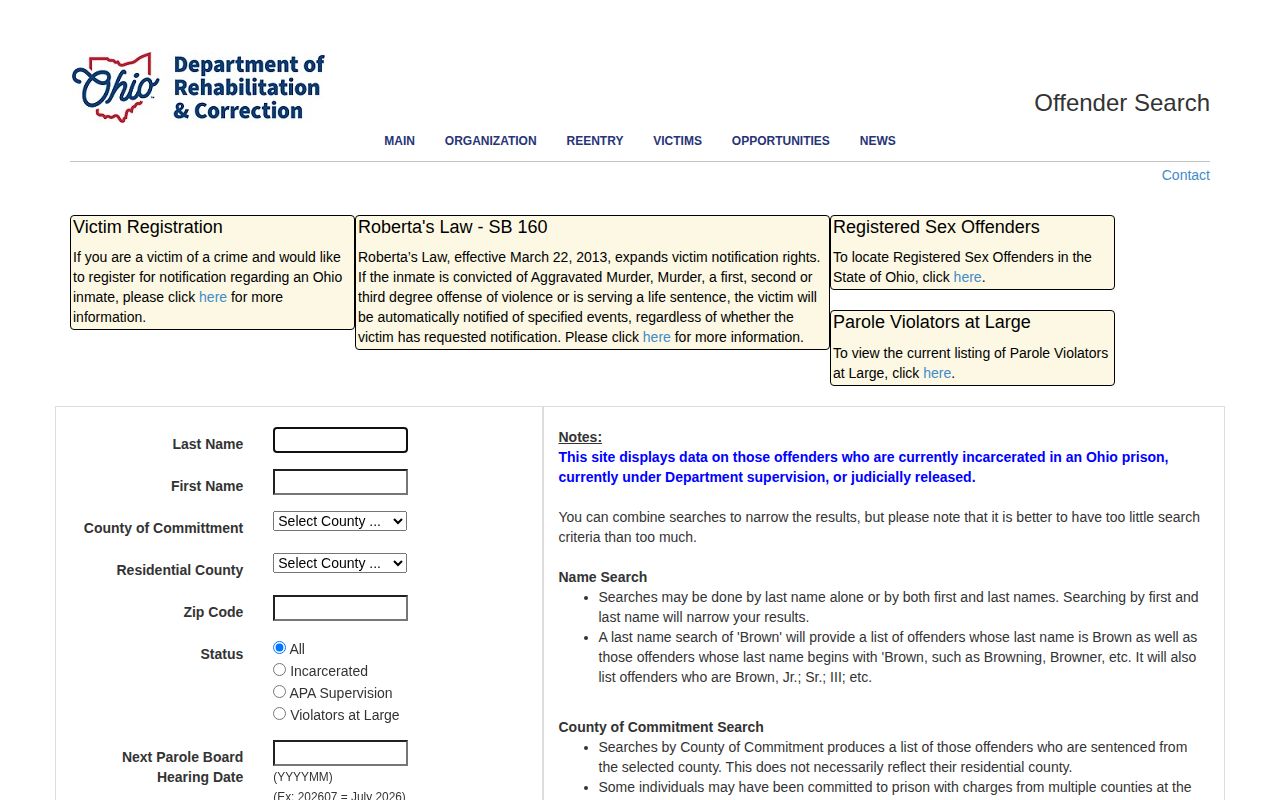
The image documents the statewide search fields; current results must be opened and verified in ODRC.
When APA supervision appears, leaving prison has been confirmed more strongly, but correctional authority continues. Local county probation is different. It arises from a court sentence and may never appear under the state APA filter.
BeCI and Belmont Are Distinct
The Belmont facility cluster contains an adult sheriff jail, an adult state prison, and two juvenile settings. Their proximity can misroute searches. Belmont County Jail uses a live local roster and sheriff release record. Belmont Correctional Institution uses ODRC. Sargus and Oakview require juvenile court or facility inquiry under confidentiality rules. A person should not be moved among these databases merely because each facility name contains Belmont or has a St. Clairsville address.
BeCI also does not establish that the underlying conviction came from Belmont County. Check the ODRC committing county and docket. If there are several cases, ODRC warns that county filtering can be incomplete because a multi-county record may be indexed under only one county. Search by ODRC number and reconcile all listed dockets before attributing a prison release to a local case.
BeCI Release Confirmation Limits
A result can change after release, a board review, a violation, or a return to custody. Date the search and copy the exact wording needed for the inquiry. An old screenshot is context, not proof of today's status. The sentencing docket may also reveal later orders that affect release or supervision. If public fields conflict, request clarification from ODRC and the sentencing clerk.
Do not use the Belmont jail's 24-hour or 72-hour pages to infer a BeCI discharge. Those pages address a missing county release feed and the local roster. They do not monitor ODRC gates. Ohio VINE can provide a custody-change alert for ODRC, but it is an alert channel rather than a lasting discharge archive. Confirm the event through ODRC status, supervision, court, and responsive discharge records.
Note: A BeCI departure and an end to APA supervision are separate events, each requiring its own current record.
BeCI Status After Supervision
The offender detail may retain an institution name after the status changes to APA supervision. Residential county and ZIP are also last-recorded data, not a live location service. If a supervised person is later listed as a Violator at Large, the public should not approach. ODRC directs law enforcement to verify any warrant through official systems. That later status does not undo the earlier prison departure, but it changes the current supervision context.
Final discharge needs its own evidence. Look for a current status without an active supervision obligation, a termination or discharge record, or a court or board entry. A supervision start date proves neither completion nor the person's present location.
BeCI Sentence Record Detail
The ODRC detail can list each offense, count, Revised Code section, effective sentence date, jail-time credit, definite or minimum and maximum term, committing county, docket number, felony degree, judge, and aggregate sentence. Those fields help reconcile an expected date with the sentence that produced it. When several cases appear, check each docket. ODRC warns that a multi-county search may be indexed under the first listed commitment county, so a Belmont filter alone can miss a relevant person.
Parole-board fields need the same exact reading. A next-review month or abbreviated result is not itself proof that the person left BeCI. A grant may still depend on plan approval or another condition, while transitional-control language concerns a distinct statutory program. Confirm the later current status and supervision start. If the record remains incarcerated, a past review result should not be restated as a completed release.
Public Record Search
Sponsored Results